

From Idea to Launch: The Custom Web Application Development Process Explained
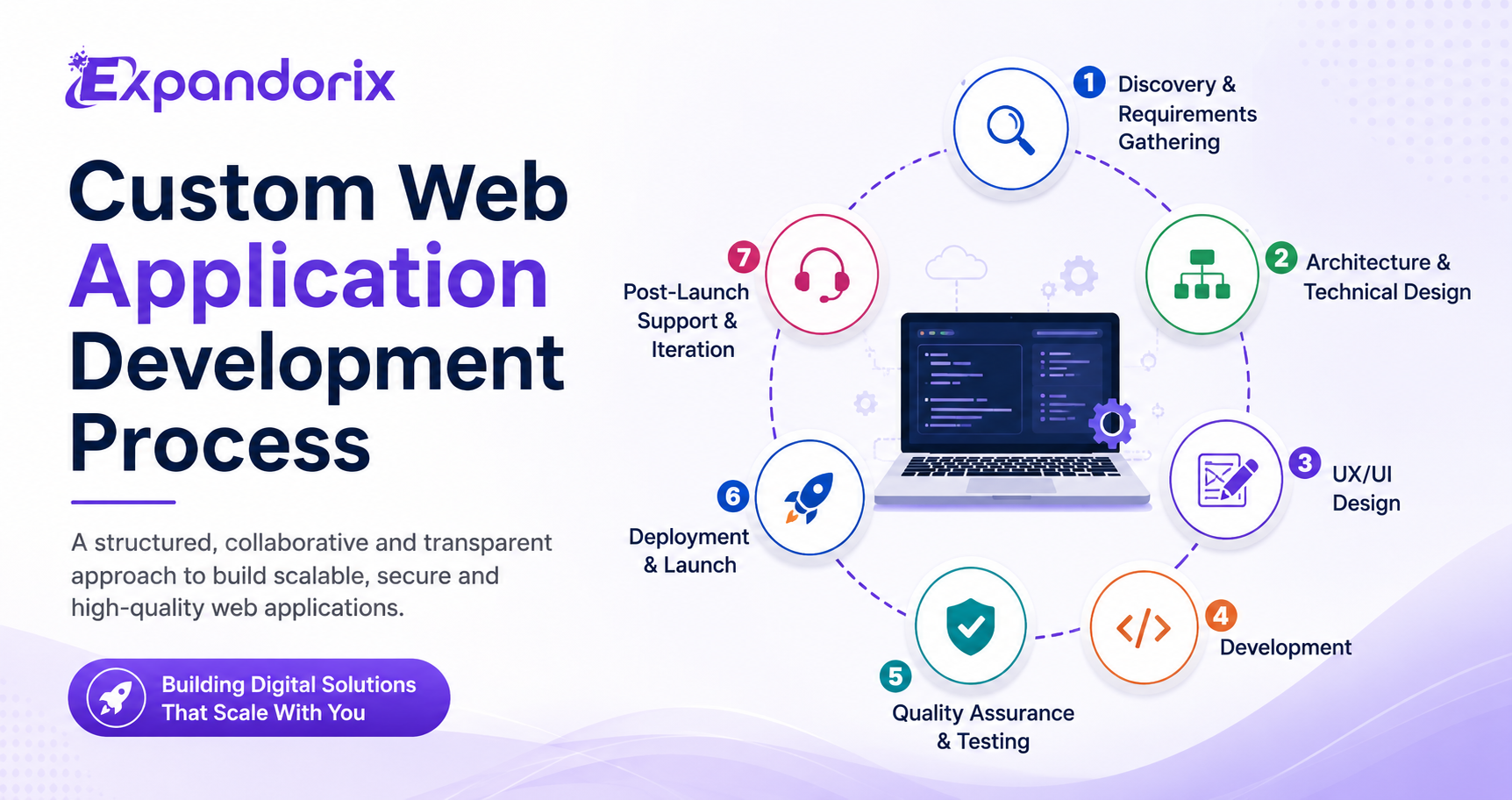
Many business owners who approach us at Expandorix start the conversation the same way: they have a problem they want solved, or an idea they want built, but they have very little visibility into what the development process actually looks like. That uncertainty creates hesitation — and sometimes stops promising projects before they begin.
This blog is designed to demystify the custom web application development process from start to finish. We will walk through every major phase, explain what happens at each stage, and clarify what we need from you as a client to keep the project moving smoothly and on budget.
Whether you are a first-time buyer of custom development services or an experienced operator evaluating a new vendor, understanding this process will help you make better decisions, set realistic expectations, and ultimately get a better product.
Phase 1: Discovery and Requirements Gathering
Every great web application starts not with code, but with conversations. The discovery phase is where we invest time understanding your business — your operations, your pain points, your goals, and your users.
At Expandorix, we conduct structured discovery sessions with key stakeholders from your organization. These might include department heads, end users who will interact with the application daily, IT staff who will maintain it, and executives who will measure its impact. Each group brings a different perspective, and all of them matter.
During discovery, we ask questions like:
- What problem is this application solving? What does "success" look like in six months?
- Who are the primary users, and what are their technical comfort levels?
- What systems does this application need to integrate with?
- Are there regulatory or compliance requirements we need to design around?
- What is the timeline, and are there external deadlines driving it?
From these conversations, our team produces a Requirements Document — a structured specification that captures functional requirements (what the system must do), non-functional requirements (performance, security, scalability), and any constraints. This document becomes the foundation of everything that follows.
One of the most common mistakes in custom development projects is rushing through discovery to get to "the real work." We disagree with that philosophy entirely. A poorly scoped project will produce a perfectly built application that solves the wrong problem. Discovery done right is the most valuable work in the entire engagement.
Phase 2: Architecture and Technical Design
Once requirements are clearly defined, our senior engineers and architects move into the technical design phase. This is where we decide how the application will be built — not just what it will do.
Key decisions made during this phase include:
Technology stack selection: We evaluate the requirements and recommend the right combination of frontend frameworks (React, Vue, Angular), backend technologies (Node.js, Python/Django, Ruby on Rails, .NET), databases (PostgreSQL, MongoDB, MySQL), and infrastructure (AWS, GCP, Azure). We don't have a one-size-fits-all stack — the right tools depend on your specific needs.
System architecture: Will this be a monolith or a microservices architecture? Will it use a REST API, GraphQL, or event-driven architecture? These choices affect scalability, development speed, and long-term maintainability.
Data modelling: We design the structure of your data — how it will be stored, related, and accessed — before any code is written. A well-designed data model prevents expensive refactoring later.
Security architecture: Authentication and authorization strategies, data encryption, API security, and vulnerability mitigation are all planned at this stage.
The output of this phase is a Technical Architecture Document and, for complex projects, a Proof of Concept that validates our core technical decisions before full-scale development begins.
Phase 3: UX/UI Design
Before any backend logic is written, we design the user experience. Great software is not just functional — it is intuitive and enjoyable to use. At Expandorix, we believe that UX design is as important as engineering.
Our design process begins with user journey mapping — understanding the paths your users will take through the application, and identifying where friction could occur. From there, we produce:
Wireframes: Low-fidelity sketches of each screen, showing layout and information hierarchy without visual design. These are fast to produce and easy to revise, allowing us to validate the structure before investing in detailed design.
Interactive prototypes: Clickable mockups that simulate the user experience. We put these in front of real users or internal stakeholders to gather feedback before development begins. This is far cheaper than discovering usability issues after launch.
High-fidelity designs: Pixel-perfect visual designs that reflect your brand, color palette, typography, and visual language. These designs are handed off to developers as the definitive guide for the frontend.
Design is an iterative process, and we expect and welcome feedback at every stage. Our goal is that by the time a single line of frontend code is written, you have seen and approved exactly what will be built.
Phase 4: Development
Development is where the application comes to life. At Expandorix, we follow Agile development methodology, working in two-week sprints. Each sprint delivers a discrete, testable set of functionality.
Here is what this means in practice for you as a client:
- You receive a demo at the end of every sprint — real, working software, not slideshows or status reports
- You can provide feedback that influences the next sprint's priorities
- If requirements change (and they almost always do, to some degree), we can accommodate that change without derailing the project
We use version control (Git), continuous integration pipelines, and automated testing throughout the development process. This is not just good practice — it is the foundation of a codebase that remains maintainable and extensible for years after launch.
Development is divided into frontend (the user interface) and backend (the server-side logic, APIs, and database interactions). Both streams run in parallel where possible, coordinated by clear API contracts agreed upon early in the sprint cycle.
Phase 5: Quality Assurance and Testing
No feature is considered "done" until it has been tested. Our QA process is multi-layered:
Unit testing: Individual functions and components are tested in isolation to verify they behave correctly.
Integration testing: We test how different parts of the system interact with each other.
End-to-end testing: Automated tests simulate real user journeys through the application, catching issues that unit tests cannot.
Performance testing: We stress-test the application to understand how it behaves under load, and optimize accordingly.
Security testing: We conduct vulnerability assessments and penetration testing to identify potential attack vectors.
User acceptance testing (UAT): Before launch, your team gets access to the application in a staging environment to validate that it meets your requirements. This is your chance to test with real scenarios and real data before going live.
Phase 6: Deployment and Launch
Deployment is a milestone, but it should feel routine — not chaotic. Because we have been deploying to staging environments throughout development, launching to production is a well-rehearsed process.
We use cloud infrastructure for deployment, typically with blue-green deployment strategies that allow us to launch without downtime and roll back instantly if anything unexpected occurs. We set up monitoring and alerting from day one, so any post-launch issues are caught immediately.
Phase 7: Post-Launch Support and Iteration
A launched application is not a finished project — it is the beginning of a product lifecycle. After launch, we provide ongoing support, bug fixes, and performance monitoring. We also partner with clients for long-term iteration — adding new features, responding to user feedback, and evolving the application as your business grows.
Conclusion
The custom web application development process is structured, collaborative, and transparent. At Expandorix, we have refined this process over hundreds of projects to minimize risk, maximize quality, and keep our clients informed and in control at every step.
If you are ready to explore what a custom application could look like for your business, reach out to Expandorix for a no-obligation discovery conversation.
Expandorix — Building Digital Solutions That Scale With You
- הפינה המשפטית
- ביטחון, אבטחה ומודיעין
- אבטחת אישים
- אבטחת מידע וסייבר
- רישוי עסקים
- אירועים תחת כיפת השמיים
- אבטחת מתקנים ואתרים
- מעברי גבול ו תעופה
- בתי ספר להכשרת ומכללות ביטחון
- כלי ירייה מטויחים וחנויות נשק
- אבטחה בתחבורה
- מנב"טים קב"טים קמעונאיים
- אחר
- הגנת הפרטיות
- מודיעין עסקי וארגוני
- פרשנות
- סיקורים
- רחפנים
- גילוי דעת
- כתבות
- מיומנו של קב"ט / מנב"ט

 Hebrew