

Multigrain Atta Vs Khapli Atta Comparison Guide
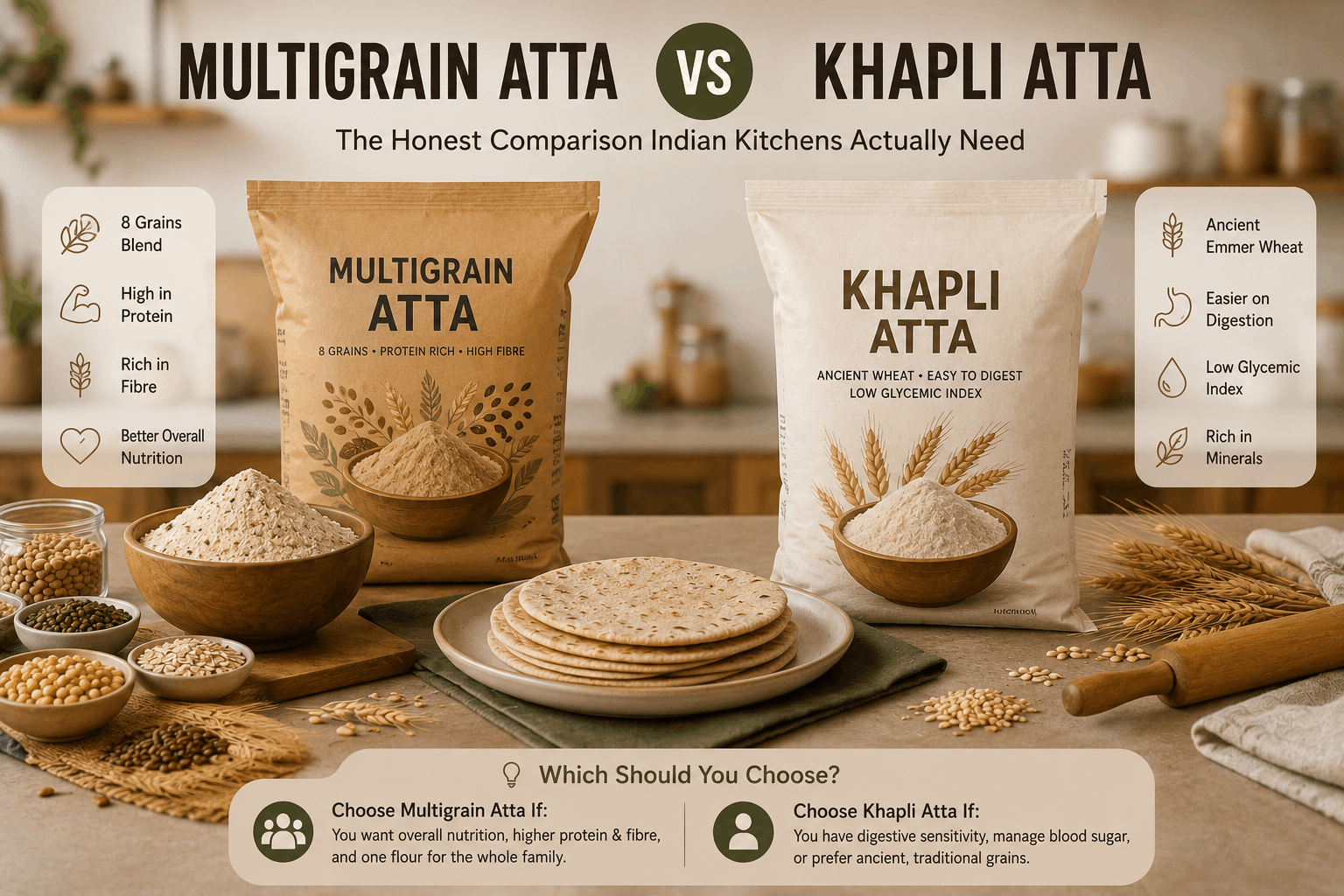
Multigrain Atta vs Khapli Atta – The Honest Comparison Indian Kitchens Actually Need
The movement toward healthier flour choices in Indian kitchens has produced a welcome abundance of options — and, inevitably, a new kind of confusion. Multigrain atta and khapli atta are two of the most frequently considered alternatives to standard commercial wheat flour. Both are genuinely nutritionally superior to refined wheat. Both are increasingly available in consistently processed forms. And both produce rotis that most Indian households adapt to without significant resistance.
The confusion arises because they're marketed in similar wellness language — "whole grain," "traditional," "natural" — without a clear explanation of how they differ, why those differences matter, and which one actually fits a given household's specific health situation and cooking needs. This article is that explanation.
What Each Flour Actually Is
Multigrain atta is a blended flour — a combination of multiple grains and typically legumes, ground together into a single flour that delivers the combined nutritional profile of all its components. A quality eight-grain blend might include whole wheat, jowar, bajra, ragi, oats, soybean, chickpea, and flaxseed. Each grain contributes something specific — protein from the legume additions, multiple fibre types from the millet and oat components, calcium from ragi, omega-3 from flaxseed. The result is a flour with broader nutritional coverage than any single grain can provide.
Khapli atta is a single-grain flour — ground from emmer wheat, one of the oldest cultivated wheat varieties in the world, predating modern commercial wheat by thousands of years. It's not a blend. It's simply a different, older, and in certain nutritional and digestive respects meaningfully better variety of wheat than what commercial milling has standardised around. Lower modern gluten content, a different starch structure, better mineral retention, and a natural grain character that modern wheat's selective breeding optimised away in favour of yield.
The Nutritional Comparison — What Each Does Better
Multigrain atta wins on breadth. The combination of eight grains and legumes produces a flour with meaningfully higher protein content than standard wheat — typically 18-20 grams per 100 grams versus 10-12 grams for whole wheat. It delivers multiple fibre types simultaneously — soluble from oats, insoluble from millets, resistant starch from chickpea. The mineral profile spans iron, calcium, magnesium, and phosphorus from different grain sources. For households trying to address multiple nutritional gaps through a single daily flour, the breadth of the multigrain blend is its defining advantage.
Khapli atta wins on digestive compatibility and glycaemic profile. Emmer wheat's lower modern gluten content makes it better tolerated by people who experience digestive sensitivity to commercial wheat — bloating, heaviness, or discomfort after wheat-heavy meals — without having diagnosed celiac disease. Its starch structure produces a lower glycaemic response than both refined wheat and most commercial whole wheat atta. For households where specific members are managing blood sugar or digestive issues linked to modern wheat, khapli's targeted advantage in these areas is significant.
Who Should Choose Which — The Decision Framework
Choose multigrain atta 10 kg as your primary daily flour if: Your household's primary need is closing a protein and fibre gap that vegetarian diets commonly carry. You're feeding multiple people across different age groups and want one flour that serves all of them reasonably well. You want broad nutritional coverage through daily roti consumption without needing to rotate multiple specialty flours. And you're buying in quantity for consistent daily use — the 10 kg format is specifically designed for households that have committed to the flour as their standard.
Choose khapli atta if: One or more household members experience digestive discomfort from commercial wheat — the bloating, heaviness, or irregularity that modern wheat's high gluten content can cause in sensitive digestive systems. A family member is actively managing blood sugar and needs the lower glycaemic response that emmer wheat's starch structure produces more reliably than standard whole wheat. Or you're interested in using a genuinely ancient grain that carries the mineral density and grain character that modern wheat lost through centuries of selective breeding.
The Cooking Comparison
Both flours produce rotis — that's the central practical compatibility they share. The cooking experience, however, differs in ways worth understanding before switching.
Multigrain atta dough typically requires slightly more water than standard wheat dough and benefits from a short rest after kneading. The rotis produced are moderately heartier than wheat rotis but remain pliable and soft. Most families adjust within a week of regular use.
Khapli atta dough requires more water than multigrain — emmer wheat's different protein structure means the dough behaves less like conventional wheat than a multigrain blend does. Rotis are firmer, slightly more dense, and carry a mild earthiness that is distinctive and, for most households, pleasant once familiar. Rolling requires slightly more care — khapli lacks the extensibility of modern wheat gluten, so the roti is best patted or rolled with a light touch rather than stretched.
Neither flour requires new recipes. Both work in thepla, paratha, and mixed-grain doughs as well as standard roti.
The Cost Comparison
Both flours carry a modest premium over standard commercial wheat atta — reflecting the sourcing, processing, and grain quality that produce their respective nutritional advantages. The premium is genuine rather than marketing-driven when the product is properly formulated and processed.
At the 10 kg scale, multigrain atta tends to offer better value per kilogram than smaller pack sizes of either flour, making it the more economical choice for households using it as a daily staple. Khapli atta's sourcing from traditional emmer wheat cultivation, which remains more limited in scale than commercial wheat farming, typically positions it at a slightly higher price point per kilogram.
For households incorporating both flours — multigrain for daily staple use, khapli for targeted use by specific household members — the combined monthly flour expenditure remains significantly below the monthly cost of addressing the same nutritional gaps through supplements.
The Honest Recommendation
For most Indian households, multigrain atta is the better starting point — broader coverage, more accessible dough behaviour, and the 10 kg format that enables the consistent daily use that produces cumulative nutritional benefit.
For households with a specific member managing blood sugar or modern wheat sensitivity, adding khapli atta alongside the multigrain blend addresses the targeted need that the broader blend doesn't prioritise.
Both are available from 10on10foods, which has built its traditional and multigrain grain range around processing integrity that preserves the nutritional character of each flour rather than compromising it for cost or shelf-life optimisation.
- הפינה המשפטית
- ביטחון, אבטחה ומודיעין
- אבטחת אישים
- אבטחת מידע וסייבר
- רישוי עסקים
- אירועים תחת כיפת השמיים
- אבטחת מתקנים ואתרים
- מעברי גבול ו תעופה
- בתי ספר להכשרת ומכללות ביטחון
- כלי ירייה מטויחים וחנויות נשק
- אבטחה בתחבורה
- מנב"טים קב"טים קמעונאיים
- אחר
- הגנת הפרטיות
- מודיעין עסקי וארגוני
- פרשנות
- סיקורים
- רחפנים
- גילוי דעת
- כתבות
- מיומנו של קב"ט / מנב"ט

 English