
How to Find a Reliable Wholesale Martial Arts Uniform Supplier
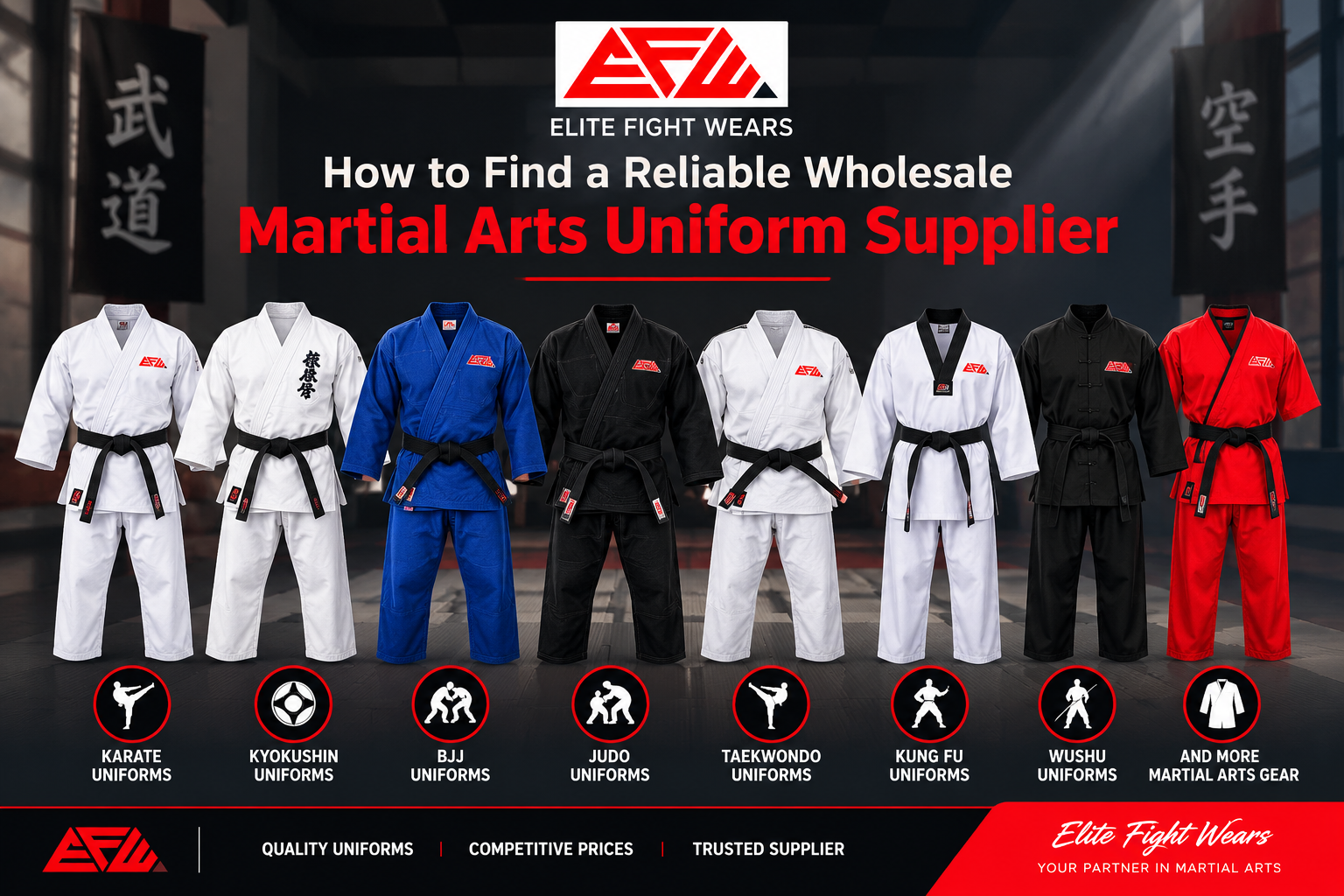
Finding a reliable wholesale martial arts uniform supplier is an important decision for martial arts academies, retailers, coaches, clubs, and distributors. The right supplier can help you maintain consistent quality, control costs, and provide uniforms that students are comfortable wearing during regular training and competitions. However, choosing a supplier only because of a low price can create problems later. Poor stitching, weak fabric, incorrect sizing, delayed production, and inconsistent quality can affect your business and your relationship with customers. A dependable supplier should offer good materials, professional manufacturing, clear communication, reasonable minimum order quantities, and reliable delivery. Before placing a large order, buyers should carefully evaluate the supplier's experience, product range, customization options, samples, pricing, and customer service. Taking time to check these areas can reduce risk and help you build a long-term supply relationship instead of constantly searching for new manufacturers.
1. Understand What Your Business Needs
Before searching for a wholesale martial arts uniform supplier, clearly identify what your business actually needs. Martial arts organizations may require different uniforms depending on their discipline, training level, and customer base. A karate academy may need lightweight karate uniforms, while a judo club may require stronger uniforms designed to handle gripping and pulling. BJJ academies usually have different requirements for gi construction, stitching, and sizing. Retailers may also need several sizes and styles to serve different customers. Make a list of the products you need, expected quantities, preferred materials, sizes, colors, branding requirements, and delivery expectations. If you need private-label products, include your logo and branding requirements in the initial discussion. Having clear requirements makes it easier to compare suppliers because you can ask every supplier the same questions. It also helps prevent misunderstandings once production begins and gives the supplier enough information to provide a more accurate quotation.
2. Check the Supplier's Manufacturing Experience
Experience is one of the most useful factors when evaluating a potential supplier. A supplier that has been manufacturing martial arts uniforms for years may have a better understanding of fabric selection, stitching techniques, sizing, cutting, embroidery, and quality control. However, experience should not be judged only by the number of years shown on a website. Ask questions about the types of martial arts uniforms they produce and the markets they serve. You can also request product photographs, production examples, or samples from previous work. An experienced manufacturer should be able to explain the differences between uniform materials and recommend suitable options according to your requirements. They should also understand that karate, judo, BJJ, taekwondo, and other disciplines can require different construction methods. A supplier that can confidently answer technical questions is generally easier to work with than one that provides only basic pricing information.
3. Review the Quality of the Fabric
Fabric quality directly affects the comfort, durability, appearance, and overall value of a martial arts uniform. A uniform can look attractive in photographs but still perform poorly if the fabric is weak or unsuitable for training. Ask the supplier what fabric they use and whether different weights are available. Lightweight materials may be suitable for certain training environments, while heavier fabrics may be preferred for disciplines where uniforms experience significant pulling and gripping. It is also important to check whether the material remains comfortable after repeated washing. Shrinkage can become a serious issue if the supplier does not properly account for it during manufacturing. Before committing to a large order, request samples whenever possible. Examine the fabric closely, wash the sample according to normal care instructions, and check whether the material changes significantly. This simple process can reveal quality problems before they affect a larger shipment.
4. Examine Stitching and Construction
Strong stitching is essential because martial arts uniforms are regularly exposed to pulling, stretching, movement, and repeated washing. A uniform may have excellent fabric but still fail quickly if the seams are poorly constructed. When reviewing samples, inspect the major stress areas carefully. Look at the shoulders, sleeves, side seams, pants, waist area, and other points that receive frequent movement. Check whether the stitching is straight, secure, and consistent. Reinforced stitching may be especially important in areas exposed to greater stress. Buyers should also examine the finishing of loose threads and seams because poor finishing can affect both appearance and durability. If you are ordering uniforms for an academy or retail business, consistency is just as important as the quality of a single sample. Ask how the supplier maintains production standards across larger orders. A professional supplier should have a quality-control process rather than depending entirely on final inspection after production.
5. Compare Wholesale Prices Carefully
Price is naturally important when purchasing martial arts uniforms in bulk, but the cheapest quotation is not always the best deal. A low price may sometimes reflect lower-quality fabric, weaker stitching, limited customization, or poor packaging. When comparing suppliers, ask what is included in the quoted price. Find out whether embroidery, patches, custom labels, packaging, or other services involve additional costs. You should also ask about shipping charges, production costs, sample fees, and any other possible expenses. Comparing the complete cost gives you a more realistic picture of your potential profit margin. A slightly higher unit price can be worthwhile if the supplier offers better materials, consistent quality, dependable communication, and fewer defective products. Retailers and academy owners should consider the total value of the product rather than focusing only on the initial quotation. The objective should be to find a supplier that provides a good balance between quality, price, service, and reliability.
6. Ask About Minimum Order Quantities
Minimum order quantity, commonly called MOQ, is another important factor when choosing a wholesale supplier. Some manufacturers require large quantities, while others are willing to work with smaller wholesale orders. The right MOQ depends on your business size, available budget, storage capacity, and expected sales. If you are testing a new product or supplier, starting with a manageable order can reduce your financial risk. Ask the supplier whether the MOQ applies to each design, color, size, or total order. This detail can make a significant difference when planning inventory. For example, a supplier may allow a certain total quantity but require minimum quantities for individual colors or designs. Clear communication about MOQ before production begins can prevent unexpected costs and delays. If your business is growing, you should also ask whether the supplier can support larger quantities later. A flexible supplier can become a valuable long-term partner as your wholesale requirements increase.
7. Check Custom Branding and Private Label Options
Custom branding can help martial arts academies and retailers create a stronger identity. If you want uniforms with your academy logo, brand name, embroidered details, custom patches, or private-label packaging, discuss these requirements before placing an order. Ask the supplier what branding methods they offer and whether they can provide embroidery, printing, woven labels, or other customization options. It is also useful to ask for examples of previous customized uniforms. This can help you understand the quality and placement of branding before approving production. For businesses building their own martial arts clothing brand, private-label manufacturing can provide additional opportunities to create unique products. Make sure the supplier understands your logo specifications, colors, dimensions, and placement requirements. Request a digital sample or production confirmation before manufacturing begins when possible. Clear approval procedures can reduce the chance of receiving products with incorrect branding.
8. Explore the Supplier's Product Range
A supplier with a broad martial arts product range may be more useful for businesses that want to source several products from one manufacturer. Instead of purchasing different products from multiple suppliers, you may be able to combine uniforms and related equipment through one reliable production partner. Depending on your market, you may need karate uniforms, judo uniforms, BJJ gis, belts, patches, training equipment, or other martial arts apparel. For example, businesses looking for different karate styles can review available wholesale karate uniforms and compare options according to their customers' requirements. Having several products available from one supplier can simplify communication, production planning, quality control, and shipping. However, a large product catalog should not automatically be treated as proof of quality. Each product category should still be evaluated separately, especially if different construction methods or materials are involved.
9. Request Samples Before a Large Order
Ordering samples is one of the safest ways to evaluate a supplier before committing to significant quantities. A sample allows you to inspect the actual product instead of relying only on photographs or descriptions. Check the material, stitching, measurements, embroidery, color, finishing, comfort, and overall construction. If possible, have a coach or experienced martial artist test the uniform during normal training. Their feedback can reveal issues that may not be obvious during a basic visual inspection. Washing the sample can also help you understand how the fabric responds to regular care. If the supplier refuses to provide any reasonable method of evaluating product quality, consider this a warning sign. A serious manufacturer should understand why wholesale buyers need confidence before placing larger orders. Samples also give you an opportunity to confirm whether the supplier can reproduce your requested specifications accurately.
10. Evaluate Communication and Customer Service
Good communication can make a major difference throughout the wholesale buying process. A supplier may produce excellent uniforms, but poor communication can still create unnecessary problems. Pay attention to how quickly and clearly the supplier responds to your questions. Do they explain pricing properly? Do they confirm product specifications? Can they provide production updates? Are they willing to discuss changes when necessary? Reliable communication becomes even more important when ordering customized products because small misunderstandings can lead to incorrect production. Before placing an order, discuss important details such as payment terms, production timelines, packaging, quality checks, and shipping. Keep important specifications in writing so both sides have a clear reference. You should also consider how the supplier handles problems. Ask what happens if products arrive damaged, incorrect, or below the agreed quality standard. A supplier's response to these questions can provide useful insight into their professionalism.
11. Check Judo and Other Specialized Uniform Requirements
Different martial arts disciplines have different uniform requirements, so a supplier should understand the specific demands of each product. Judo uniforms, for example, must handle gripping and pulling during training and competition. Buyers searching for a specialized judo uniform wholesale option should pay attention to fabric weight, jacket construction, reinforcement, stitching, pants quality, and sizing. The same principle applies to BJJ, karate, and other martial arts. Do not assume that a supplier experienced in one type of uniform automatically produces every other category to the same standard. Ask discipline-specific questions and request relevant samples. This is particularly important for academies because students may train several times each week, placing considerable stress on their uniforms. A product that looks good for casual use may not perform well during intensive training. Choosing products based on actual training requirements helps protect both your investment and your customers' satisfaction.
12. Review Production and Delivery Timelines
Production and shipping times should be discussed before confirming a wholesale order. Delays can create serious problems for retailers preparing seasonal inventory or academies ordering uniforms for new students. Ask the supplier how long sample development, production, quality inspection, packaging, and shipping normally take. If the uniforms are customized, allow additional time for logo approval and production preparation. It is also important to understand that production time and shipping time are separate. A supplier may finish manufacturing on schedule, but transportation can still take additional days or weeks depending on the destination and shipping method. Ask whether the supplier provides tracking information and how they handle unexpected delays. Businesses should also avoid promising customers delivery dates until the supplier has confirmed a realistic timeline. Good planning gives you enough time to receive, inspect, and organize the products before they are needed.
13. Verify Quality Control Before Shipment
A professional quality-control process can prevent many problems from reaching the customer. Ask the supplier how products are checked before shipment and whether they inspect measurements, stitching, fabric, colors, branding, and quantities. For customized orders, quality control should also confirm that logos and labels match the approved specifications. Larger orders can contain hundreds of individual pieces, so consistency is extremely important. If possible, establish clear quality standards before production starts. You can specify acceptable measurements, fabric requirements, branding placement, and packaging expectations. Photographs or videos of completed products may also help you review an order before shipment, depending on the supplier's process. The goal is not to make the process unnecessarily complicated but to create clear expectations. When both buyer and supplier understand what acceptable quality means, there is less room for disagreement after production is completed.
14. Build a Long-Term Supplier Relationship
Finding a reliable supplier should not be viewed as a one-time purchase. A strong long-term relationship can make future orders easier, faster, and more consistent. Once you find a supplier that meets your standards, communicate your expectations clearly and provide useful feedback after each order. Keep records of successful products, sizing information, colors, branding specifications, and packaging requirements. This can make repeat orders much simpler. You can also discuss future product development if your business grows. A manufacturer that understands your brand can become more valuable over time because they already know your quality expectations. However, continue monitoring quality even after several successful orders. Standards should remain consistent as order quantities increase. A reliable relationship is built through communication, transparency, quality, and mutual respect rather than simply placing repeated orders.
15. Choose Reliability Over the Lowest Price
The best wholesale martial arts uniform supplier is not necessarily the one offering the lowest price. Reliability comes from several factors working together, including product quality, manufacturing experience, communication, customization capability, production consistency, reasonable pricing, and dependable delivery. Businesses should take time to compare suppliers instead of making a decision based on one quotation. Start by defining your requirements, request samples, inspect the construction, ask detailed questions, compare total costs, and establish clear expectations before placing a large order. If a supplier meets these standards consistently, you may have found a valuable long-term partner. For businesses seeking a dedicated martial arts uniform and equipment source, Elite Fight Wears is one option buyers can explore when comparing suppliers and product solutions. A careful selection process can help you avoid common wholesale problems and create a more dependable supply chain for your martial arts business.
Frequently Asked Questions
1. What should I check before choosing a martial arts uniform supplier?
Check fabric quality, stitching, sizing, manufacturing experience, customization options, MOQ, pricing, production time, shipping, and customer service. Requesting samples is also highly recommended before placing a large order.
2. Should I choose the cheapest wholesale supplier?
Not necessarily. A very low price may come with lower-quality materials or inconsistent production. Compare the complete value, including quality, customization, service, shipping, and reliability.
3. Why are samples important for wholesale orders?
Samples allow you to inspect the actual fabric, stitching, sizing, finishing, and branding before investing in a large quantity. They can help identify problems early.
4. Can martial arts uniforms be customized?
Yes. Many manufacturers offer options such as academy logos, embroidery, patches, labels, colors, and private-label branding. Requirements should be confirmed before production.
5. What is MOQ in wholesale martial arts uniforms?
MOQ means Minimum Order Quantity. It is the smallest quantity a supplier requires for an order or particular product, design, color, or size.
6. How can I build a long-term relationship with a supplier?
Maintain clear communication, provide accurate specifications, pay according to agreed terms, give constructive feedback, and regularly check product quality. Consistency from both sides helps build a strong business relationship.
If you would like to post a free guest post, visit [Site Name] to learn more.
- הפינה המשפטית
- ביטחון, אבטחה ומודיעין
- אבטחת אישים
- אבטחת מידע וסייבר
- רישוי עסקים
- אירועים תחת כיפת השמיים
- אבטחת מתקנים ואתרים
- מעברי גבול ו תעופה
- בתי ספר להכשרת ומכללות ביטחון
- כלי ירייה מטויחים וחנויות נשק
- אבטחה בתחבורה
- מנב"טים קב"טים קמעונאיים
- אחר
- הגנת הפרטיות
- מודיעין עסקי וארגוני
- פרשנות
- סיקורים
- רחפנים
- גילוי דעת
- כתבות
- מיומנו של קב"ט / מנב"ט

 Hebrew