

Debt Recovery from Related Companies: Identifying Common Risks for Creditors
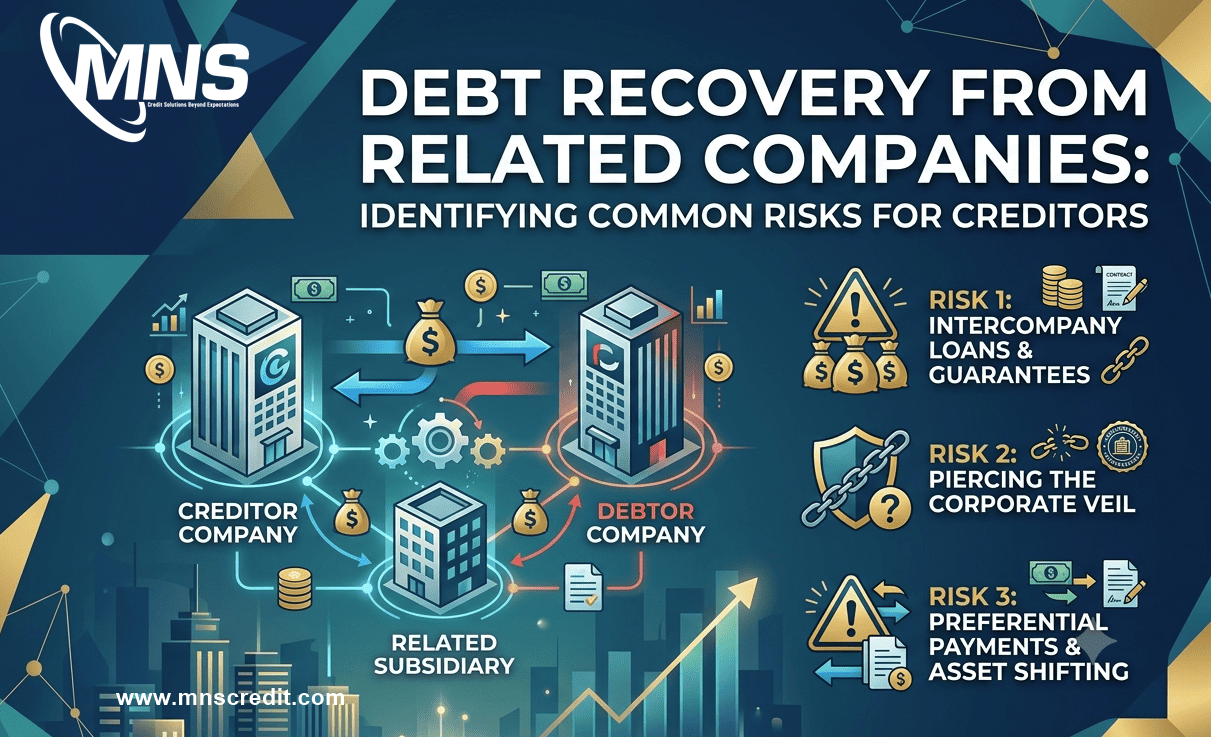
Trading with a company that belongs to a corporate group often feels reassuring. The group name, shared branding and common management suggest stability. Yet when an invoice goes unpaid, the same structure can become a source of difficulty. Debt collection from related companies requires creditors to look beyond the contracting entity and understand how the group operates, where assets sit and who is legally responsible. Identifying the common risks early gives creditors a better chance of recovering what they are owed.
The Legal Starting Point: Separate Entities
In most jurisdictions, each company in a group is a separate legal person. A creditor who contracts with one subsidiary generally has a claim against that subsidiary only, not against its parent or sister companies, even where they share directors, offices and a trading identity. Exceptions exist, such as guarantees, agency arrangements, or limited circumstances in which courts disregard the corporate form, but these are not the norm and are difficult to establish.
This principle is the root of many recovery problems. A creditor may believe it is dealing with a large and well-resourced group, only to find that its contract sits with a thinly capitalized entity.
Common Risks for Creditors
Thin capitalization of the contracting entity. Groups often use special-purpose or operating subsidiaries that hold few assets of their own. Valuable property, equipment or intellectual property may be held by another group company. If the contracting entity fails to pay, there may be little to enforce against.
Intercompany balances and cash pooling. Related companies frequently lend to each other or pool cash centrally. Funds received by one entity may be swept to another, leaving the debtor without liquidity. Intercompany claims may also compete with, or rank alongside, external creditors in an insolvency.
Unclear contracting party. Invoices, purchase orders and emails may be issued by or to different group entities. Where the paperwork is inconsistent, it can be difficult to prove which company agreed to pay.
Transfers of assets and business. Moving assets, contracts or customers to a related company, sometimes shortly before default, can leave the original debtor unable to pay. Depending on the circumstances, such transfers may be open to challenge, but proving this takes time and evidence.
Shared management and conflicts of interest. Where the same individuals control several companies, decisions about which creditor to pay and which entity to preserve may be driven by group interests rather than by the creditor's rights.
Cross-border structures. Related companies in different countries add layers of jurisdiction, enforcement procedure and insolvency law. A judgment against one entity may not be directly enforceable against another, and recognition of foreign proceedings varies widely.
Reliance on informal assurances. Verbal comfort that the parent will stand behind the subsidiary, or that a support group exists, has little legal value unless it is documented in an enforceable form.
Early Warning Signs
Creditors can spot potential problems by watching for the following:
- A contracting entity with a short trading history or minimal filed assets.
- Payment instructions that direct funds to another group company.
- Invoices disputed or paid late by one entity while others in the group appear to be trading normally.
- Frequent changes in group structure, directors or registered addresses.
- Group accounts that show significant intercompany balances.
- Reluctance to provide guarantees or audited financial information.
Reducing Risk Before Credit Is Granted
The strongest protection is built at the outset. Before extending credit, creditors should identify precisely which entity is the contracting party and verify its legal details. They should review its financial position independently of the group's reputation, and understand how it fits in the group structure.
Where the contracting entity is weak, the creditor should consider asking for a parent company guarantee, a letter of undertaking backed by legal analysis, security over assets, or joint and several liability among relevant group companies. Credit limits should reflect the standing of the entity that will actually be liable, not that of the group as a whole.
Contracts should name the correct entity, define payment obligations clearly and include notification obligations for changes of control or restructuring.
Managing Recovery Once Payment Is Overdue
When a related-company debtor falls behind, the creditor should act quickly and methodically.
Establish the facts. Confirm the legal entity that owes the debt, review group structure and ownership, and identify where assets and receivables are held.
Review available rights. Check for guarantees, security, retention of title and any direct contractual relationship with other group companies. Consider whether any entity acted as agent or made representations that may support a claim.
Engage at the right level. Sometimes the most effective route is to contact the parent or group finance team directly. Even where there is no legal liability, reputational and commercial pressure within the group can lead to settlement.
Preserve evidence. Keep records of orders, delivery, approvals, correspondence and any statements by group representatives about who would pay.
Consider formal steps. Depending on the facts, this may include demand letters, legal proceedings, interim protective measures or insolvency options. Where asset movements between group companies appear suspicious, early legal advice is important.
The Role of Investigation
Professional debt collection often involves investigating the group beyond the debtor. Corporate registry searches, ownership mapping, asset tracing and market inquiries can reveal where value sits and which entities are active. This intelligence supports better decisions about whether to negotiate, litigate or pursue security, and it can strengthen arguments if the creditor needs to challenge transactions.
Conclusion
Debt collection from related companies is rarely as simple as it looks. Separate legal personality, asset shifting, intercompany arrangements and cross-border structures can all limit what a creditor can recover from the entity it contracted with. By identifying these risks at the outset, documenting the correct parties, securing guarantees where needed and acting promptly when payments are slow, creditors can protect their position. Where the group is large or the structure is complex, specialist investigation and legal guidance can make a decisive difference.
- הפינה המשפטית
- ביטחון, אבטחה ומודיעין
- אבטחת אישים
- אבטחת מידע וסייבר
- רישוי עסקים
- אירועים תחת כיפת השמיים
- אבטחת מתקנים ואתרים
- מעברי גבול ו תעופה
- בתי ספר להכשרת ומכללות ביטחון
- כלי ירייה מטויחים וחנויות נשק
- אבטחה בתחבורה
- מנב"טים קב"טים קמעונאיים
- אחר
- הגנת הפרטיות
- מודיעין עסקי וארגוני
- פרשנות
- סיקורים
- רחפנים
- גילוי דעת
- כתבות
- מיומנו של קב"ט / מנב"ט

 Hebrew